 akar.earth
Blue Carbon: Mangroves, Seagrass and Tidal Wetlands
Blue carbon in Indonesia: how mangrove, seagrass and tidal wetland projects work under VM0033, soil carbon measurement, pond rehabilitation and policy.
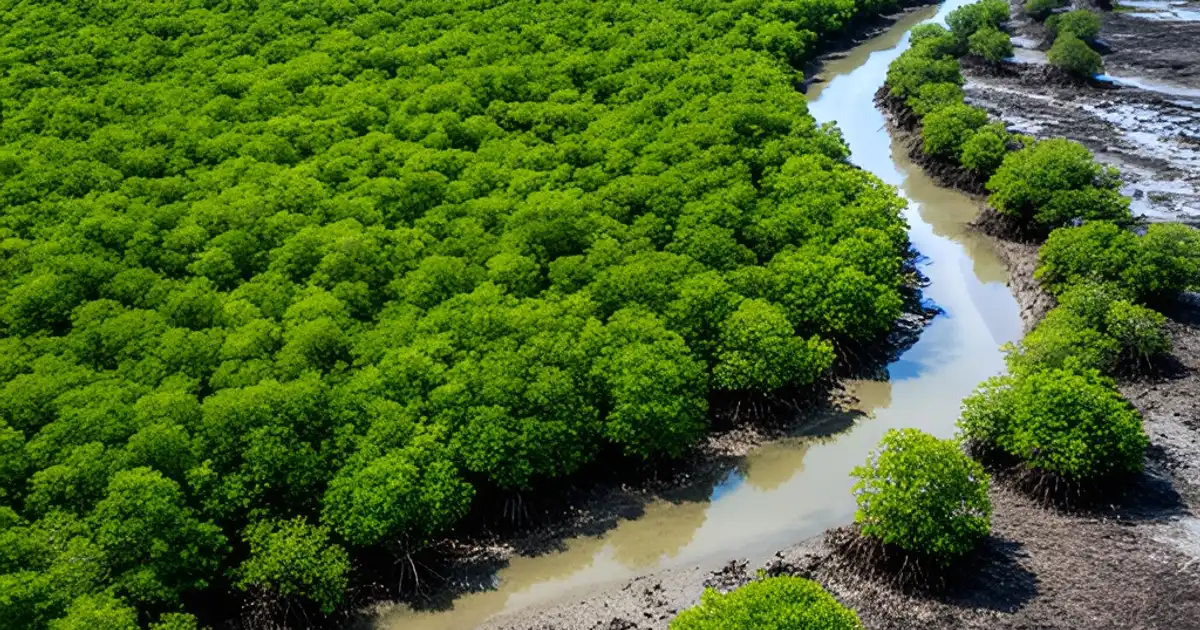
Blue carbon is the carbon stored by mangroves, seagrass meadows and tidal wetlands, most of it in waterlogged soils that can hold it for centuries. Indonesia has the largest mangrove area of any country, so mangrove restoration and conservation are among its most important carbon project types.
This hub explains how blue carbon projects work, how they differ from forest projects on land, what VM0033 requires, and what Indonesian policy means for developers and coastal communities.
Why blue carbon is different
A mangrove stand holds carbon in trunks, branches and roots, like any forest. The difference is below ground. Tidal flooding keeps the soil waterlogged and low in oxygen, so organic matter decomposes very slowly and builds up over long periods. In many mangroves the soil stock is larger than the tree stock.
That has three consequences for projects:
- Big stocks per hectare. Conversion of mangroves, especially to aquaculture ponds, releases soil carbon as well as biomass carbon.
- Measurement is harder. You need soil cores, bulk density and carbon content, not only tree inventories. See measuring mangrove soil carbon.
- Hydrology decides success. Planting seedlings where tides do not reach, or on mudflats that were never mangrove, fails. Restoration works when water flow is restored first.
Mangrove vs terrestrial forest carbon compares the two side by side.
A mental model: water, sediment, trees, people
| Layer | Question | Common failure |
|---|---|---|
| Water | Do tides reach the site at the right frequency and depth? | Planting behind dykes or on high ground |
| Sediment | Is sediment building or eroding? | Coastal erosion undermining the site |
| Trees | Which species suit the elevation and salinity zone? | Single-species Rhizophora planting everywhere |
| People | Who uses the coast and who owns the ponds? | Pond owners or fishers left out of benefit sharing |
Project types
Mangrove restoration. Re-establishing mangroves on degraded or converted land. Abandoned shrimp and fish ponds are the main opportunity in Indonesia, because their hydrology can often be restored by breaching pond walls. Rehabilitating abandoned aquaculture ponds to mangrove covers the engineering and tenure questions. Mangrove restoration carbon projects step by step covers the full project cycle.
Mangrove conservation. Protecting existing mangroves from conversion. This works like REDD+, with a baseline of expected loss. See the REDD+ hub.
Seagrass. Seagrass meadows store carbon in sediment, but measurement, additionality and permanence are harder to prove. Seagrass carbon: science and crediting limits explains why seagrass credits remain rare.
Peat and tidal wetlands. Coastal peat swamps sit between blue and green carbon. Rewetting drained peat is covered in the REDD+ hub and by peatland protection rules.
The methodology: VM0033
Verra’s VM0033 covers tidal wetland and seagrass restoration. It accounts for biomass, soil carbon and, where relevant, methane and nitrous oxide emissions that can offset some of the soil gains in lower-salinity sites. It also requires projects to consider sea-level rise and sediment supply when estimating long-term carbon. Check the current version and applicability conditions on the Verra website before designing a project.
Community-focused projects sometimes use Plan Vivo, which emphasises local governance and benefit sharing. Co-benefit labels such as CCB are common, because mangroves protect coasts and support fisheries.
Species
Indonesian mangroves are species-rich, and species zone by elevation and salinity. The species section profiles five common restoration species:
- Rhizophora apiculata and Rhizophora mucronata, the most planted genus, often overused.
- Avicennia marina, a pioneer on seaward and disturbed sites.
- Bruguiera gymnorrhiza and Sonneratia alba, which fill other zones.
Mixed-species planting that matches natural zonation tends to survive better than monoculture Rhizophora rows.
Indonesian policy
Mangrove rehabilitation has been a national priority, and blue carbon touches several ministries: forestry for mangroves inside the forest estate, marine affairs for coastal and seagrass areas, and local government for spatial planning. Carbon trading sits under Perpres 110/2025, with exchange-traded units recorded in SRUK. Permenhut 6/2026 covers forestry carbon trading, including community participation. Blue carbon policy in Indonesia maps which rules apply where. The Indonesian regulation hub covers the wider framework.
Measurement and monitoring
Blue carbon monitoring combines soil coring, tree plots, elevation surveys and remote sensing of canopy extent. Survival counts after planting matter: a restoration site that loses most seedlings in the first year will not deliver its ex-ante estimate. Drone imagery and RTK-surveyed plots make change easier to verify in tidal sites where access is difficult. The dMRV hub covers these tools in general.
Common mistakes
- Planting on mudflats. Bare mudflats and seagrass beds are often not former mangrove. Planting there tends to fail and can damage other habitats.
- Ignoring pond tenure. Abandoned ponds may still have owners or users who expect compensation or a role in the project.
- Skipping soil data. Without soil cores, the largest carbon pool goes unmeasured, and conservative defaults may undervalue the project.
- Counting seedlings, not survival. Planted numbers make good headlines, but credits depend on trees that survive and grow.
- Overlooking methane. In lower-salinity sites, methane can offset part of the soil gain and must be accounted for.
Getting started
- Map historical mangrove extent and current land use, especially ponds.
- Check tenure: ponds are often held privately even when the land sits in the forest estate.
- Assess hydrology before choosing species.
- Design soil and biomass sampling before planting.
Our field data campaigns cover RTK plot mapping, drone surveys and soil sampling for coastal sites. Every blue carbon page is listed below.
Frequently asked questions
What is blue carbon?
Blue carbon is carbon stored in coastal and marine ecosystems, mainly mangroves, seagrass meadows and tidal marshes. Most of it sits in waterlogged soil, where it can remain for centuries if the ecosystem stays intact.
Why is Indonesia important for blue carbon?
Indonesia has the largest mangrove area of any country, along with extensive seagrass. Large areas of mangrove were converted to aquaculture ponds, which creates restoration opportunities.
Which methodology do mangrove carbon projects use?
Verra's VM0033 covers tidal wetland and seagrass restoration. Mangrove conservation can also be credited under REDD+ methodologies. Check the current version on the Verra website before designing a project.
Can seagrass projects earn carbon credits?
In principle, under VM0033, but seagrass carbon is harder to measure and to prove additional, so very few seagrass credits exist. Most blue carbon credits come from mangroves.
Comparisons
- Mangrove vs Terrestrial Forest Carbon
Mangrove vs terrestrial forest carbon in Indonesia: carbon pools, soil carbon, methodologies, measurement and risks, and when blue carbon makes sense.
Glossary
- Blue carbon: Definition
What is blue carbon? Carbon stored in mangroves, seagrass and tidal marshes, how it is measured for credits, and why Indonesia is a global blue carbon leader.
- Mangrove: Definition
What is a mangrove? Why salt-tolerant coastal forests store so much carbon, how mangrove carbon is measured, and Indonesia's restoration opportunity.
- Peatland: Definition
What is peatland? How tropical peat stores carbon, why drained peat burns and emits, how peat carbon is measured, and Indonesia's peat rules and projects.
- Seagrass: Definition
What is seagrass? How seagrass meadows store blue carbon in sediments, why seagrass credits are still rare, and what Indonesia's meadows mean.
- WRC: Definition
What is WRC (wetlands restoration and conservation)? How WRC carbon projects restore peat and tidal wetlands, which methodologies apply, and Indonesian fit.
Guides
- Rehabilitating Abandoned Aquaculture Ponds to Mangrove
How to turn an abandoned shrimp pond back into mangrove in Indonesia: tenure, hydrology, planting choices, carbon methodology fit and common mistakes.
- Blue Carbon Policy in Indonesia
Blue carbon policy in Indonesia explained: which rules apply to mangrove and seagrass carbon, who is responsible, and what to check before you start.
- Mangrove Restoration Carbon Projects Step by Step
Mangrove restoration carbon credits step by step: hydrology, eligibility, VM0033 and other methodologies, planting choices and monitoring in Indonesia.
- Measuring Mangrove Soil Carbon
Mangrove soil carbon measurement guide: coring to depth, bulk density, organic carbon analysis, sampling design and how to account for uncertainty in Indonesia.
- Seagrass Carbon: Science and Crediting Limits
Seagrass carbon credits explained: how seagrass stores carbon, why crediting is harder than for mangroves, and what to check before an Indonesian project.
Tree species
- Avicennia marina: Growth, Allometry and Carbon Potential
Avicennia marina (api-api) carbon sequestration: pioneer mangrove ecology, wood density, mangrove allometry, blue carbon role and restoration risks.
- Bruguiera gymnorrhiza: Growth, Allometry and Carbon Potential
Bruguiera gymnorrhiza carbon sequestration: mangrove ecology, Indonesian names, wood density, mangrove allometry, blue carbon role and risks.
- Rhizophora apiculata: Growth, Allometry and Carbon Potential
Rhizophora apiculata carbon sequestration: mangrove ecology, Indonesian names, wood density, mangrove allometry, charcoal rotations and blue carbon role.
- Rhizophora mucronata: Growth, Allometry and Carbon Potential
Rhizophora mucronata carbon sequestration: mangrove ecology, Indonesian names, wood density, Komiyama and Chave allometry, blue carbon role and planting risks.
- Sonneratia alba: Growth, Allometry and Carbon Potential
Sonneratia alba (pedada) carbon sequestration: seaward pioneer ecology, wood density, mangrove allometry, blue carbon role and restoration risks in Indonesia.