 akar.earth
Afforestation, Reforestation and Revegetation (ARR) Carbon Projects
ARR carbon projects in Indonesia: how VM0047 works, land eligibility, species choice, growth modelling and smallholder aggregation, in one practical overview.
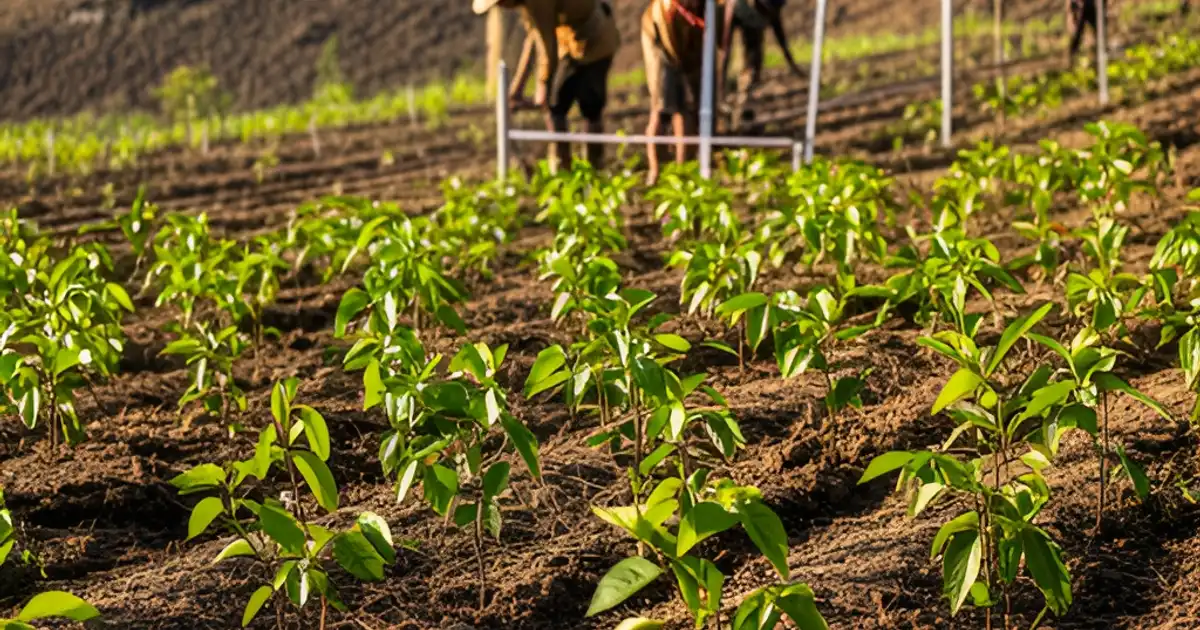
An ARR carbon project plants or regenerates trees on land that is not forest today and earns removal credits for the carbon those trees take up. In Indonesia most new ARR projects are designed under Verra’s VM0047, which pairs remote sensing with field plots to prove growth beyond what would have happened anyway.
ARR is the project type most buyers mean when they ask for “removals”. This hub covers the method, the land and species decisions, the numbers and the work of bringing smallholders in.
Why ARR matters in Indonesia
Southeast Asian nature-based supply so far has been dominated by REDD+. Of the 129 million credits the region issued under VCS and Gold Standard to April 2025, Indonesia produced 59.3%, mostly from avoided deforestation. Buyers who need removals for net-zero claims are now looking for ARR supply, and Indonesia has large areas of degraded land, abandoned plantations and smallholder farms where trees can be added.
ARR also fits Indonesian policy. Permenhut 6/2026 names social forestry groups, customary forests and communities as legitimate participants in forestry carbon trading. Smallholder tree planting on farms and in social forestry areas can be structured to fit that framework.
How VM0047 works
VM0047 v1.1 has been effective for all projects since 14 May 2025. It offers two ways to quantify removals:
- Area-based approach. The project area and a set of control plots outside it are tracked with remote sensing. A dynamic performance benchmark, built from how vegetation changes on the control plots, sets the baseline. Plot sampling inside the project measures carbon stocks. Credits reflect growth above the benchmark. See the area-based approach.
- Census-based approach. Every planted tree is counted and measured, which suits smaller and scattered plantings such as trees on smallholder farms. See the census-based approach.
The main methodology page, VM0047, covers applicability conditions, carbon pools and monitoring. If you are comparing with the older CDM tool set, read VM0047 vs AR-ACM0003.
A mental model: land, trees, tonnes, people
Think of an ARR project as four layers that must each hold up under verification.
| Layer | Key question | What fails most often |
|---|---|---|
| Land | Was this land non-forest, and can you prove it? | Missing historical imagery, unclear tenure |
| Trees | Will the planted species survive and grow here? | Poor nursery stock, low survival, wrong species for site |
| Tonnes | How much carbon, measured how? | Optimistic growth curves, weak plot design |
| People | Who owns the trees and carbon, and who benefits? | No consent records, vague benefit sharing |
Land. ARR needs evidence that the land was not forest before the project. Land eligibility for ARR explains how to prove this with historical imagery. Indonesian tenure adds a second test: who holds the right to plant and to claim carbon.
Trees. Species selection balances carbon, livelihoods, native ecology and permanence. Fast-growing exotics such as acacia or eucalyptus give quick tonnes but raise biodiversity and harvest questions. Native and multipurpose species such as meranti, durian or candlenut grow slower but often hold up better with communities and buyers. The species section has profiles for 30 species. Plan for losses with seedling survival and replanting budgets.
Tonnes. Ex-ante carbon estimation forecasts credits before planting, using growth models and allometric equations. Ex-ante numbers drive financing, so they must be conservative and defensible. Try the ARR carbon estimator or the single tree CO2 calculator for a first figure.
People. Most Indonesian ARR potential sits on land held by smallholders and communities. Aggregating smallholders into one ARR project covers enrolment, consent and payment design. Grouped project design explains how VCS lets you add new areas over time.
Costs and timing
ARR is front-loaded. Nursery, planting, maintenance and early monitoring costs land in the first three to five years, while credit volumes start small and rise as trees grow. What an ARR project costs breaks down the budget lines and the drivers that move them. Developers often bridge the gap with prepayment, offtake agreements or blended finance; see the climate finance hub.
Removals and integrity
ARR credits are removals, which many buyers value more highly than avoidance credits. They still face integrity questions: additionality, permanence if trees are harvested or burned, and leakage if planting displaces farming. VM0047’s dynamic benchmark addresses part of the additionality question. Buffer contributions under the AFOLU non-permanence risk tool cover reversal risk. For the label buyers increasingly ask for, read the ICVCM CCP label explainer.
ARR and EUDR on the same land
Many ARR plantings sit in landscapes that also grow coffee, cocoa or rubber for export. The plot polygons, tree inventories and imagery that support an ARR monitoring report can also support EUDR geolocation and deforestation-free evidence. The agroforestry hub covers this overlap.
Common mistakes
- Planting before proving eligibility. If you cannot show the land was not forest, no amount of planting will earn credits. Pull historical imagery first.
- Using one growth curve for every site. Growth varies with soil, rainfall, elevation and maintenance. Calibrate models with local plot data as soon as trees are measurable.
- Ignoring mortality. Survival in the first two years often decides whether the ex-ante estimate is met. Budget for replanting.
- Monoculture by default. A single fast-growing exotic simplifies logistics but can weaken biodiversity claims, community support and buyer interest.
- Late monitoring design. Plots, control areas and boundary data should be designed before planting so the baseline and first measurements are clean.
- Vague farmer agreements. Smallholders need to know who owns the trees, what they may harvest and how carbon revenue is shared, in writing and in their own language.
Getting started
- Run the ARR project feasibility checklist.
- Screen land history and tenure.
- Build a conservative ex-ante model by species and planting year.
- Design plots and monitoring before planting, not after.
Our carbon modelling service builds ex-ante scenarios by species, site and planting schedule, and feeds them into project documentation. Every ARR page is listed below.
Frequently asked questions
What is an ARR carbon project?
An ARR project plants or regenerates trees on land that is not currently forest and earns removal credits for the extra carbon the trees store. In the voluntary market most new ARR projects use Verra's VM0047.
Which methodology do ARR projects in Indonesia use?
Most use Verra VM0047, version 1.1 of which has been effective for all projects since 14 May 2025. Alternatives include Gold Standard A/R requirements, Plan Vivo PV Climate for community projects and the older CDM AR-ACM0003 and AR-AMS0007.
Can smallholder farms form an ARR project?
Yes. Many farms can be grouped under one project design, and VM0047 offers a census-based approach suited to smaller plantings where every tree is counted. Consent records, tenure evidence and benefit sharing need to be in place from the start.
How long before an ARR project earns credits?
Trees take years to accumulate measurable biomass, so early verifications are small. Many developers use ex-ante modelling and prepayment or offtake agreements to fund the first years.
AKAR tools
- AKAR Carbon Simulator: Ex-Ante Carbon Scenarios
AKAR Carbon Simulator models ex-ante carbon scenarios for ARR, agroforestry and mangrove projects: growth, survival, deductions and credit timing.
Comparisons
- VM0047 vs AR-ACM0003
VM0047 vs AR-ACM0003 for ARR projects in Indonesia: baselines, additionality, remote sensing, tools, program status and which methodology to use now.
Glossary
- Above-ground biomass: Definition
What is above-ground biomass (AGB)? Definition, how it is measured with plots, allometry and remote sensing, and why it drives forest carbon credits.
- Afforestation: Definition
What is afforestation? Definition, how it differs from reforestation, how carbon standards treat it, and what it means for Indonesian ARR projects.
- Allometric equation: Definition
What is an allometric equation? How tree diameter, height and wood density convert to biomass and carbon, with notes for Indonesian forest projects.
- ARR: Definition
What is ARR (afforestation, reforestation and revegetation)? How ARR carbon projects work, VM0047 measurement, and what makes ARR viable in Indonesia.
- Basal area: Definition
What is basal area? The cross-sectional stem area per hectare, how to calculate it from DBH, and how forest carbon projects in Indonesia use it.
- Below-ground biomass: Definition
What is below-ground biomass (BGB)? Definition, how root biomass is estimated with root-to-shoot ratios, and how carbon projects in Indonesia account for it.
- Biomass expansion factor: Definition
What is a biomass expansion factor (BEF)? How it converts stem volume or biomass to whole-tree biomass, and when Indonesian projects should avoid it.
- Canopy cover: Definition
What is canopy cover? Definition, how it is measured from the ground, drones and satellites, and why it decides forest definitions for carbon and EUDR.
- Carbon fraction: Definition
What is the carbon fraction of biomass? The IPCC 0.47 default, how it turns dry biomass into carbon and CO2, and when to use other values.
- DBH: Definition
What is DBH (diameter at breast height)? How it is measured at 1.3 m, special cases like buttresses and stilt roots, and its role in forest carbon.
- Dynamic performance benchmark: Definition
What is a dynamic performance benchmark? How VM0047 uses control plots and remote sensing to set ARR baselines and test additionality, with Indonesian notes.
- Root-to-shoot ratio: Definition
What is a root-to-shoot ratio? How it converts above-ground biomass to root biomass in forest carbon accounting, and how to pick one for Indonesia.
- Wood density: Definition
What is wood density? Definition of basic wood density, why it matters in allometric biomass models, and typical ranges for Indonesian tree species.
Guides
- What an ARR Project Costs: Budget Lines and Drivers
Reforestation project cost per hectare explained: the budget lines, what drives cost in Indonesia, and how to model ARR costs over a full crediting period.
- ARR Project Feasibility: A 10-Point Checklist
ARR feasibility checklist for Indonesia: land eligibility, tenure, additionality, growth, costs, communities, methodology fit and buyer route in ten checks.
- Ex-Ante Carbon Estimation for Tree Planting
Ex-ante carbon estimate guide for tree planting: growth, survival, buffer and uncertainty deductions, and how to keep projections conservative.
- Grouped Project Design Under VCS
Grouped project VCS guide: geographic areas, eligibility criteria and project activity instances, and how to design a grouped ARR project in Indonesia.
- Land Eligibility for ARR: Proving No Forest Cover
ARR land eligibility explained: the 10-year no-clearing rule, forest definitions, and how to prove non-forest status with satellite and field evidence.
- Seedling Survival Rates and Replanting Budgets
Seedling survival rate in reforestation: what drives mortality in Indonesia, how to measure survival, and how to budget replanting realistically.
- Aggregating Smallholders into One ARR Project
Smallholder carbon aggregation in Indonesia: grouping farmers into one ARR or agroforestry project, contracts, benefit-sharing, data and verification needs.
- Species Selection for Carbon and Livelihoods
Species selection for reforestation in Indonesia: balance carbon, native biodiversity, farmer income, site fit and permanence with a simple scoring method.
Services
- Ex-Ante Carbon Modelling and DNDC Soil Modelling
Ex-ante carbon modelling and DNDC soil modelling for ARR, agroforestry and soil carbon projects in Southeast Asia, with transparent, auditable assumptions.
Topic
- Tree Species for Carbon Projects in Indonesia
Tree species for carbon projects in Indonesia: profiles of 30 timber, fruit, agroforestry and mangrove species with growth, wood density, allometry and fit.
Tree species
- Acacia mangium: Growth, Allometry and Carbon Potential
Acacia mangium carbon sequestration: native range, pulp rotations, wood density, allometry, ARR role, and invasiveness and disease risks in Indonesia.
- Agarwood / Gaharu (Aquilaria malaccensis): Growth, Allometry and Carbon Potential
Agarwood (gaharu) carbon sequestration in Indonesia: range, inoculation and harvest, light wood density, allometry, CITES, agroforestry role and risks.
- Bamboo in Indonesian Restoration: Growth, Allometry and Carbon Potential
Bamboo carbon sequestration in Indonesian restoration: species, clump growth and culm harvest, culm-based allometry, eligibility questions and risks.
- Cacao (Theobroma cacao): Growth, Allometry and Carbon Potential
Cacao carbon sequestration in Indonesia: range, productive life, wood density, cocoa-specific allometry, shade-tree agroforestry, EUDR and key risks.
- Candlenut / Kemiri (Aleurites moluccanus): Growth, Allometry and Carbon Potential
Candlenut (kemiri) carbon sequestration in Indonesia: range, growth and productive life, wood density, allometry, agroforestry role and risks.
- Cinnamon (Cinnamomum burmannii): Growth, Allometry and Carbon Potential
Cinnamon (cassia vera) carbon sequestration in Indonesia: Kerinci range, bark harvest cycles, wood density, allometry, agroforestry role and risks.
- Clove (Syzygium aromaticum): Growth, Allometry and Carbon Potential
Clove carbon sequestration in Indonesia: Maluku origin, long productive life, wood density, allometry, agroforestry role, disease and price risks.
- Coconut (Cocos nucifera): Growth, Allometry and Carbon Potential
Coconut carbon sequestration in Indonesia: palm biology, productive life, why tree allometry does not fit, palm biomass methods, agroforestry role and risks.
- Arabica Coffee (Coffea arabica): Growth, Allometry and Carbon Potential
Arabica coffee carbon sequestration in Indonesia's highlands: range, productive life, coffee allometry, shade agroforestry, EUDR and climate risks.
- Robusta Coffee (Coffea canephora): Growth, Allometry and Carbon Potential
Robusta coffee carbon sequestration in Indonesia: range, productive life, allometry for coffee shrubs, shade-tree agroforestry, EUDR and risks.
- Durian (Durio zibethinus): Growth, Allometry and Carbon Potential
Durian carbon sequestration in Indonesian agroforestry: range, productive life, wood density, allometry, carbon role, livelihoods and key risks.
- Eucalyptus pellita: Growth, Allometry and Carbon Potential
Eucalyptus pellita carbon sequestration in Indonesia: range, pulp rotations, wood density, allometry, ARR suitability, water, fire and monoculture risks.
- Gmelina (Gmelina arborea): Growth, Allometry and Carbon Potential
Gmelina carbon sequestration in Indonesia: range, short rotations, wood density, Chave 2014 allometry, ARR and agroforestry role, and key risks.
- Jabon (Neolamarckia cadamba): Growth, Allometry and Carbon Potential
Jabon carbon sequestration in Indonesia: ecology, rotation, wood density range, allometry with Chave 2014, ARR role, harvest and permanence risks.
- Jackfruit (Artocarpus heterophyllus): Growth, Allometry and Carbon Potential
Jackfruit carbon sequestration in Indonesian home gardens and agroforestry: range, growth, wood density, allometry, livelihoods and risks.
- Mahogany (Swietenia macrophylla): Growth, Allometry and Carbon Potential
Mahogany carbon sequestration in Indonesia: range, growth, wood density, Chave 2014 allometry, ARR and agroforestry role, pests and invasiveness risks.
- Meranti (Shorea spp.): Growth, Allometry and Carbon Potential
Meranti carbon sequestration: Shorea ecology, slow but long-lived growth, wood density range, dipterocarp allometry, restoration role and risks in Indonesia.
- Nutmeg (Myristica fragrans): Growth, Allometry and Carbon Potential
Nutmeg carbon sequestration in Indonesia: Banda origin, long productive life, wood density, allometry, spice agroforestry role and key risks.
- Nyamplung (Calophyllum inophyllum): Growth, Allometry and Carbon Potential
Nyamplung carbon sequestration in Indonesia: coastal range, growth, wood density, allometry, coastal ARR and greenbelt role, seed oil livelihoods and risks.
- Oil Palm (Elaeis guineensis): Growth, Allometry and Carbon Potential
Oil palm carbon sequestration explained: palm biology, 25-year cycles, time-averaged stock, palm allometry, peat and deforestation risk, and EUDR.
- Petai (Parkia speciosa): Growth, Allometry and Carbon Potential
Petai carbon sequestration in Indonesian agroforestry: native range, growth, wood density, allometry, nitrogen fixation, livelihoods and risks.
- Rubber (Hevea brasiliensis): Growth, Allometry and Carbon Potential
Rubber tree carbon sequestration in Indonesia: range, tapping life and replanting cycle, wood density, allometry, jungle rubber agroforestry, EUDR and risks.
- Sengon (Falcataria falcataria): Growth, Allometry and Carbon Potential
Sengon carbon sequestration explained: growth, rotation, wood density, allometry, ARR and agroforestry role, and harvest risks in Indonesia.
- Teak (Tectona grandis): Growth, Allometry and Carbon Potential
Teak carbon sequestration in Indonesia: range, rotation, wood density, Chave 2014 allometry, ARR and smallholder role, harvest and permanence risks.
- Ulin / Ironwood (Eusideroxylon zwageri): Growth, Allometry and Carbon Potential
Ulin (Borneo ironwood) carbon sequestration: very dense wood, slow growth, range, allometry, conservation status and its role in Indonesian restoration.
Free tools
- ARR Carbon Estimator
Free ARR carbon estimator: get an indicative tCO2e range for a tree-planting project in Indonesia from area, species group, years, survival and deductions.
- Single Tree CO2 Calculator
Free single tree CO2 calculator: estimate above-ground biomass and CO2 stored in one tropical tree from diameter, height and wood density (Chave et al. 2014).